Showing posts with label RIDS. Show all posts

Monday, May 20, 2013

Nepal Expected to Reach Drinking Water MDG

Community water filter in Nepal

A joint press statement released by the United Nations Development Program and the government of Nepal announced that Nepal is slated to reach its Millennium Development Goal target of improved drinking water facilities. Nepal has made remarkable progress over the last 12 years; however, there is still some way to go. Safe drinking water is closely linked to sanitation, yet one third of people in Nepal still do not have access to sanitation facilities. Those without access often live in poor, rural communities, isolated from modern facilities. 
In order to improve progress in drinking water access and sanitation nationwide, several groups are committed to bringing tools and knowledge to rural villages. RIDS Nepal, a partner of Friends of Humanity, outfits rural communities with its “Family of Four” initiative, which installs solar power, smokeless stoves, pit latrines, and drinking water systems in all of the village homes. RIDS works with local communities to carry out the installation processes, and trains community members in maintenance and repairs so as to ensure self-sufficiency should something break. While there is still a long way to go in ensuring all of Nepal has access to safe drinking water, the efforts to close the gap have had significant success in water access and other areas.
Nepal is also slated to meet MDG targets for reducing the proportion of people below the national poverty line, achieving 100 percent enrollment in primary education, and reducing child and maternal morality. While other MDG targets, including achieving full and productive employment, reducing hunger, and improving the environment, are further from reach, there are still 1,000 days remaining to accelerate action before the deadline for the MDG Goals in Nepal.
To learn more about Friends of Humanity’s contribution to improving drinking water access in Nepal, click here.

Friday, April 19, 2013

Alternative Energy Debates in Nepal

Solar PV cells adorn the roofs of homes in the village of Mohoriguan

Kathmandu, March 29—Despite the fact that most of Nepal’s urban residents have turned to solar power, officials at the country’s main power utility, Nepal Electricity Authority (NEA), do not believe in the feasibility of solar power. An article in Power Engineering quotes one executive as saying, “solar power is just ornamental.” In reality, it is anything but.
Solar power is the way of the future, especially in Nepal where traditional hydro power supplies consistently fail to meet the demands of the population. Though hydropower may be limited, sunshine is not; Nepal enjoys an average of 300 sunny days per year, and can generate an average of 5 kW/m². While diesel-generated electricity can cost up to Rs 30 per unit, the cost of solar energy is less than half that amount, and dropping. The NEA’s arguments that solar power is expensive and cannot be retained through reverse metering have been refuted by a number of experts, including Professor Jagan Nath Shrestha of the Pulchok Engineering Campus and Ram Prasad Dhital, assistant director at the Alternative Energy Promotion Center. Unfortunately, institutional barriers to change prevent solar energy from being widely adopted, despite consumer frustrations at constant power shortages and cuts.
Still, the NEA remains skeptical, even after solar photovoltaic systems set up to feed the power grid—one of which was set up at the Rural Integrated Development Services (RIDS) Nepal, a partner of Friends of Humanity—proved successful at transmitting surplus d
aytime power.
While much of the debate centers around urban areas, RIDS Nepal has proven the benefits of solar power in rural communities through installing solar panels in villages as part of the Family of Four initiative, and has installed nearly 700 solar lighting systems to date, limiting the environmental impact of the villages while encouraging self-sustainability.
Click here to help Friends of Humanity support RIDS Nepal and the Family of Four initiative.

Wednesday, April 25, 2012

Global Giving: A New Way to Help

Friends of Humanity is constantly working to find new tools to spread awareness about our projects and give you new ways to help. One of these ways is Global Giving.


The organization Connects Donors to Doers:

GlobalGiving begins with the dedicated, tenacious individuals who are driving change in their communities. From running orphanages and schools, to helping survivors of natural disasters, these people are do-gooders to the core. We connect these "good idea people" with the "generous giver people" and help projects of all sizes receive donations of all sizes.


We now have our four current projects on Global Giving:
Maison Shalom-Support 100 sexually abused girls in Burundi
Alice Project - Let's support a School for 125 children in India!
Lamp of the Path  - Feed 80 Homeless People in Ulaanbataar, Mongolia
RIDS-Nepal - Build wells for 200 villagers in rural Nepal

Here's How the Process Works

  • Project Leaders post their causes and details about what they need on GlobalGiving.org - giving you an inside look at the project's unique needs and work being done.
  • You make a tax-deductible donation and we combine your giving with other generous folks doing the same thing.
  • We ensure that at least 85% of your donation is sent to the organization implementing the project you chose within 60 days. Donors have the option to cover GlobalGiving's 15% fulfillment fee, in which case 100% of the original donation goes directly to the implementing organization.
  • You get regular updates telling you what a difference your gift is making and the results that have been achieved.


By researching and implementing a variety of fundraising initiatives, Friends of Humanity is able to reach a larger about of people, minimize administration costs, and remain an efficient, effective NGO. Help share our work using Global Giving's Facebook Share and Tweet functions.

Thursday, March 22, 2012

Happy World Water Day 2012!

Friends of Humanity is proud to observe International World Water Day. The UN and its member nations devote this day to implementing UN recommendations and promoting concrete activities within their countries regarding the world's water resources. Let's take a look at the facts...


According to UN facts reported by Water.org, 3.575 million people die yearly due to water related disease. That is the equal to the entire city of Los Angeles. These diseases spread because nearly 884 million people lack access to clean water. These shocking statistics indicate there is still a need to provide developing nations with clean water resources. 


World Water Day reminds us to do our part to preserve and protect this limited, vital resource. Personal water consumption in developed nations far outweighs that of a developed nation. 
An American taking a five-minute shower uses more water than a typical person in a developing country slum uses in a whole day. According to UN-WaterWater use has been growing at more than the rate twice of population increase in the last century. As a Geneva based organization, we are obliged to point out that 
In 60 percent of European cities with more than 100,000 people, groundwater is being used at a faster rate than it can be replenished.


Present water consumption rates endager our future. By 2025, 1,800 million people will be living in countries or regions with absolute water scarcity, and two-thirds of the world population could be under stress condition.

In light of these facts, we must all do our part to help those in need and be conscious of our own water consumption.

Watch a video produced by the UN Food and Agriculture Organization

Friday, March 9, 2012

MDG Drinking Water Target Being Met is Cause for Celebration

According to the World Health Organisation (WHO) and UNICEF joint monitoring program for water supply and sanitation (JMP), between 1990 and 2010 more than 2 billion people gained access to improved drinking water sources, such as piped supplies and protected wells.This means that the world has met the Millennium Development Goal set in 2000 to provide 88% of the world with access to drinking water. This progress has not been driven by just big middle-income countries – smaller, less well-endowed countries have also shown the way. This goal was met through the cooperation of governments, international organizations, and a wide range of non-governmental organizations, such as Friends of Humanity. Providing access to water for more than 2 billion people in less than 25 years is a major accomplishment that proves that all actors, big and small, can have a major impact in global development when they work together.

According to a recent Guardian article, "783 million people still do not have access to drinking water... That is more than one in 10 people in the world. It is perhaps particularly depressing when one considers who these people are, where they live, and the impact this has on their lives. In addition, the other part of the same millennium development goal target – relating to access to adequate sanitation – is still off track." Although there has clearly been significant progress in developing water resources in the last twelve years, a lot more work needs to be done to fulfill the basic human right to water.

For example, according to the World Water Organization, the 17% of the urban population and 29% of the rural population in Nepal still does not have sufficient access to water. As the 14th poorest nation in the world, Nepal faces significant structural challenges in overcoming this problem. In fact while the global rates of water access may be improving, The National Water Plan for Nepal reports that the number of absolute poor has almost doubled in the last 20 years. The World Water Organization goes on to report that, "It is estimated that 15,000 children die each year due to diarrheal diseases ‘caused by poor environmental sanitation and lack of access to quality water supply’ (Nepal’s Department of Water Supply and Sewerage). Although much of the urban population has access to a water source, there is still a huge shortage. Kathmandu has a demand for 200 million liters daily, but the government reports only being able to supply 160 million liters."

It is imperative that individuals and organizations work together to do all that they can to assist  extremely poor nations like Nepal. Friends of Humanity currently supports the RIDS Family of Four Project in Mohorigaun, Jumla District, Nepal that provides drinkable water, latrines, electricity, and smokeless metal stove to improve living conditions, sanitation, and access to water.

Monday, January 23, 2012

An inspiring story born out of sadness

Education is one of the main fields where Friends of Humanity operates, therefore we are extremely attentive to any interesting story on this subject. This time we point the reader's attention on a very touching tale of pain and solidarity.

A Japanese man, whose only child died of a rare liver disease, has been building schools and other infrastructures in Nepal after meeting a young Nepalese girl with the same disease as her daughter's, and after a trip to Nepal where he came into contact with the devastatingly poor health and hygiene conditions in that country.

Yujiro Ishimaru (in the picture right), now 68, started this activity in 1998, when her daughter was still alive (she died in 2001) and he was president of the Biliary Artesia Child Help Society in Japan. He realized how much Nepal needed to improve on its educational and health facilities, and put his energy and professional experience to this end. To this date the Asia Friendship Network, initiated by Ishimaru, has already built or expanded 40 schools, thus providing access to education to an increasing number of students.

This is the same spirit behind which our partners in the region, RIDS-Nepal and the Alice School Project in India, work. Therefore, we wish more people will get involved in activities like the one Mr. Ishimaru started.

You can read the full article here.

Wednesday, December 21, 2011

Emigration is always a key issue in Nepal

Today we speak about Nepal, one of the country where FOH has been involved for a long time and where we are currently support the Family of Four project of our partner RIDS-Nepal.

Being Nepal one of the poorest country in Asia, a consistent number of Nepalese seek their fortune abroad, and the consequences of this phenomenon can be complex. On the one hand, the remittance of emigrant workers are a big help to the local economy, and this article analyzes the important contribution given by women in this process; on the other hand, as Amnesty International points out here, many Nepalese emigrants become victims of traffickers, and while they were promised a decent job they found themselves in a condition of exploitation and forced labour.

FOH  has been directly involved against human trafficking at the beginning of its activity, and we continue keeping a careful eye on this issue. We hope that improving living conditions at home, on which RIDS-Nepal is working with the help of Friends of Humanity and the contribution of our donors, will result in less Nepalese citizens seeking fortune abroad in such unsafe and dangerous ways.

Friday, December 2, 2011

At 15 she raises funds to build a school in Nepal

At Friends of Humanity we are always on the lookout to find actions going towards solidarity, and we are particularly when they come from women, according to the spirit of our founder and CEO Graziella Zanoletti, who became first a successful entrepreneur then decided to devote her energy to humanitarian causes, due to the belief that women possess a special energy and a more effective way of doing things.

That's why the story of Sam Terry (photo right), the 15-year old Canadian girl who managed to raise $ 32,000 to build a school in Nepal, caught our attention and made us leap of joy for observing what a young woman can achieve out of enthusiasm and perseverance.

Her actions would be of course worth praising regardless of the country where her effort was aimed, but the fact that the school built thanks to Sam's fundraising is in Nepal, makes it all the more emotional for us. Nepal is the country Russell Brice, the co-founder of FOH, lives in and loves, and one of our current partners, RIDS-Nepal is active there.

We hope that many more people, young and less young, will follow Sam Terry's example and take action to help building schools and other things which will help improving the living conditions of many people in the developing world.

Thursday, October 27, 2011

Watch FOH on YouTube

Check out on the four projects we are currently supporting by visiting our You Tube page.


Alice Project in India, Maison Shalom in Burundi, Lamp of the Path in Mongolia and RIDS-Nepal are shown and explained there, and more videos will follow to illustrate our projects and activities.

Monday, September 26, 2011

A Day to Share 2011

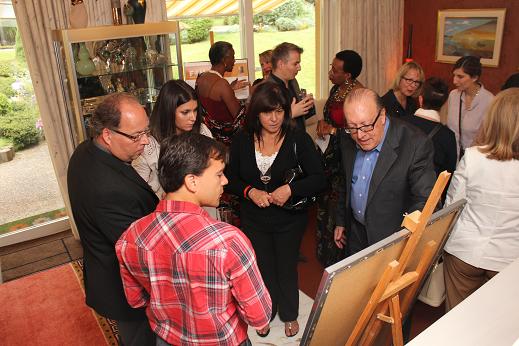
The third annual DAY TO SHARE took place on Sunday, September 18, in Onex. More than 80 guests gathered to support FOH and our partners in the field.

Maggy Barankitse spoke of her latest project set up by Maison Shalom in Burundi, a center to support young girls who have been sexually abused, while Luigina De Biasi presented the third school of the Alice Project in India, this one in a remote and mountainous area of the Arunachal Pradesh state.

Friends of Humanity has supported Maison Shalom and the Alice Project for a few years and we are continuing work with them, as it is clear how our contributions are being translated into direct action.

This year there were also two new partners: Massimo Corona talked about the Lamp of the Path project in Ulaan Bataar, Mongolia, and put his work in the proper historical context, while the last partner, the NGO Rids-Nepal, with the Family of Four project, was explained through a movie.

The presenters had the opportunity to exchange their experiences and let their project be known to other professionals in the humanitarian field as well as the general public.

The main goal of the day was to collect funds for the four projects, and this was achieved by direct donations from the guests and through a raffle and auctions. The items for these two events have been graciously offered by a number of sponsors, and the Friends of Humanity team would like to thank them for their support.

An exhaustive list of our sponsors can be found on our website, but here we would like to express our special gratitude to the Four Season Hotel des Bergues, which provided us with a five star brunch for free, and to the team of volunteers that worked extensively in the previous weeks to make this event possible.

A special thanks to Fabienne Feldman, host of the event, who welcomed us in her private residence.


Tuesday, August 23, 2011

Reeling the Family of Four

We are less than four weeks away from our annual A Day to Share event, and we would like to take this opportunity to talk a bit more about one of the partners we are helping this year, the Nepal-based NGO RIDS-Nepal, whose main task is installing and implementing the basic pillars of decent life in rural households.

Here you can find a video explaining how the Family of Four system is put in place, and the improvements occuring in every aspect of the Nepalese's lives: the improved hygiene thanks to the pit latrines and a proper system of drainage for drinking water, a homely space where they can breathe freely thanks to the smokeless metal stoves and the electricity that allows them to bypass the use of jharro wood, which is very smokey and therefore very damaging to the lungs.

RIDS-Nepal had to pause its work in the region due to the civil war that affected Nepal for most of the last decade, but they resumed their activities in 2009, and with the help of Friends of Humanity they hope to finalize the Family of Four project in the Mohoriguan Village.

You can find more videos of RIDS' activity on their Youtube page.

Tuesday, August 16, 2011

A Day to Share 2011: one month to the big event

The Friends of Humanity staff is finalizing preparations for the 3rd annual A Day to Share. September 18 is barely a month away and this beautiful event is coming together nicely.

The four projects FOH is going to support this year will be represented on the day of by their directors or deputies: Maggy Barankitse will be there, and she will talk about the new development of her Maison Shalom, a center for sexually-abused children; Massimo Corona will also be present, as director of the most recent partner of FOH, called Lamp of the Path, based in Mongolia, where it supports homeless people with a soup kitchen and other projects, such as a health center and a sewing laboratory.

As for other two projects, the Alice Project will be represented by Luigina De Biasi, who will talk about the new school in Bodhigatta; the fourth partner is RIDS-Nepal, whose Family of Four idea is already underway in rural Nepal, and with the help of FOH and our friends, they hope to finalize it soon.

You can find more information about A Day to Share on our website.

We would also like to take this opportunity to present this year's auction and raffle, and thank all our partners and sponsors for making them both possible. You can find a list of all the exceptional prizes that will be at the auction, the silent auction and the raffle by clicking on the respective link.

Monday, July 25, 2011

Re-birth of the Mohorgaun village Holistic Community Project

FOH new partner RIDS-Nepal is currently working on a project called Family of 4, where four different aspects are developed together, in order to improve all the basic needs of the community at the same time.


1. the construction and distribution of pit latrines, which will improve the hygiene conditions in the area
2. smokeless metal stoves, to replace the current system of wood firing, which fills the households with smoke
3. sources of electricity, mainly through the implementation of solar panels
4. the access to clean drinking water, through a more rational approach to the use of water courses.

After the outstanding implementation of “Family of 4” project by RIDS-Nepal in Mohorgaun Village, the civil war and political instability halted the project for an appalling 8 years. But in 2010 the project was revived. Director Alex Zahnd was able to revisit the village and the enthusiastic village community requested the continuation of the long term affiliation. Thus came about the Rebirth of the Mohorgaun Village Holistic Community Project.
By the end of December 2010, RIDS-Nepal installed in all 32 households 3 of the 4 “Family of 4”: Pit Latrines, Smokeless Metal Stoves and Basic Indoor
Lighting (powered by solar energy) as well as some of the “Family of 4 PLUS” program components: 2 Greenhouses, 5 Slow Sand Water Filter and 5 Solar Driers.

But what happened to the last of the “Family of 4”: access to clean drinking water? Well this year is all about the Mohorgaun Village Water Source Plan; which aims to design and build a village drinking water system, which will simultaneously curb the likelihood of attaining waterbourne diseases. With 3 of the 4 “Family of 4” projects in place in each household in the village, they are ready to implement the final aspect: the village drinking water system. Not forgetting to acknowledge that it’s not just RIDS-Nepal’s concept but the Mohorgaun Village as a community who strongly requested it as well.

RIDS-Nepal and the Mohorgaun Village project will be introduced and hopefully receive an important amount of funding during the A Day To Share event, coming up on September 18.

Tuesday, July 5, 2011

A Day To Share: two months to go

Our biggest event of the year is approaching. In a little more than two months from now, on September 18, A Day to Share will take place in Onex.

During the day the three projects we are focusing on this year will be presented. The renowned Marguerite (Maggy) Barankitse will speak of Maison Shalom in Burundi and its work in helping sexually-abused children. Luigina De Biasi, the co-founder of the Alice Project schools in India and a receiver of FOH help since last year, will introduce the primary school in Bodhisatta, where 125 children from the battered Chakma people are already studying. There will also be a space for the third project, a brand-new partnership for FOH, the Nepal-based RIDS-Nepal, with the concept called Family of 4, which assists in providing water, electricity, smokeless stoves and latrines to the households at the same time. Unfortunately Alex Zahnd, the director of RIDS-Nepal, will not be able to attend, but a documentary will be shown to explain the inner-workings of his NGO.

The event will be a gathering with music and entertainment, as well as an auction and a bingo. We are aiming to collect 20.000 CHF for each project. You can find more information on the event on our website.

Thursday, June 23, 2011

A new partner in Nepal for Friends of Humanity

RIDS-Nepal is an organisation based in Katmandu with several projects in rural areas of Nepal, particularly the poorest and most remote ones.  Its philosophy is to introduce sustainable development in all areas of life in a rural community, and its activity is mainly centered in off the beaten track districts such as Humla.

RDIS-Nepal is currently working on a project called Family of 4, where four different aspects are developed together, in order to improve all the basic needs of the community at the same time. The four pillars RDIS-Nepal is working on are:
  1. the construction and distribution of pit latrines, which will improve the hygiene in the area
  2. smokeless metal stoves, to replace the current system of wood firing, which fills the households with smoke
  3. sources of electricity, mainly through the implemeting of solar panels
  4. the access to clean drinking water, through a more rational approach to the use of water courses
                                                    
Friends of Humanity is proud to announce this new partnership, which will be officially presented on September 18, at the A Day to Share event in Onex, in the Geneva countryside.

For more information on RIDS-Nepal, visit the website and to know more on FOH and donate, check out www.friendsofhumanity.ch.