Showing posts with label India. Show all posts

Friday, May 10, 2013

Arunachal Pradesh Faces Power Crisis

Generator used by Alice School and surrounding community

The state of Arunachal Pradesh has been facing a power crisis for the past two and a half months, as reported by Zee News. The demand for power far exceeds the grid’s capacity, which can provide up to 84 Megawatts.  However, the supply often fluctuates between 34 Megawatts and 84 Megawatts during peak hours, compared with a peak hour demand of 130 Megawatts. The ever-increasing demand can be attributed to small and medium development and infrastructural projects being implemented all over the state.
A solution to the problem is apparent in the many rivers that traverse the state; Arunachal Pradesh has an estimated capacity of 58,000 Megawatts of hydropower. Despite the huge opportunity, only micro hydropower projects are currently generating power to meet localized needs. With many rivers drying up, larger hydropower projects are stunted even before they are implemented.
Thus, attention must be given to environmental preservation, as well as alternative energy sources, to ensure that Arunachal Pradesh can keep up with growing power demands, especially in rural areas.
The village of Boddishata Deban, where Friends of Humanity’s partner, the Alice School is located, is plagued by power cuts and shortages of electricity. In an effort to stem the problem, the school has purchased a generator for community use, which has helped to mitigate the problem, in addition to ensuring the school and adjoining hostel have a reliable power supply.
While small community efforts have success in fulfilling local needs, a larger plan of action is needed to ensure power capacity meets demand across the growing state of Arunachal Pradesh.

To learn more about the Alice School and its impact in the community, click here.

Thursday, April 25, 2013

India Celebrates Global Action Week

Students at the Alice School in Arunachal Pradesh, India

This week in India, schoolchildren are celebrating Global Action Week, put on by the National Coalition for Education (NCE), a national level voluntary organization that promotes children’s rights. The theme of the week is “Every Child Needs a Teacher,” and aims to bring awareness to the critical shortage of qualified teachers in the region.
As part of the campaign, NCE highlights the discrepancy between public and private education. According to the India Education Diary:
While children of private schools go well with all facilities at schools, remaining are those poor kids who are tied with a bad luck in a government school. Children of public school face numerous challenges on the way to their free, compulsory and quality elementary education. Majority of public school face shortage of teachers which impact adversely on those poor kids.”
In order to fulfill the goal of providing universal primary education for all, there must be real efforts to filling the teacher gaps in elementary schools with qualified candidates.
During Global Action Week, NCE will organize interactions amongst teachers, parents, and members of the School Management Committee to discuss quality education and the role played by teachers. Students will participate as well by sending postcards to the Honorable Governor asking for immediate intervention in filling the teacher gaps in their respective schools.
By influencing all involved parties, NCE is highlighting the integrated effort needed to ensure all children have access to a free, high quality education. Moreover, by involving students themselves, they are empowering youth to speak out for their rights and to demand access to one of the fundamental building blocks of a bright future.
To learn more about Friends of Humanity's committment to education, or to donate to one of our education projects, click here.

Monday, April 22, 2013

Earth Day 2013!

Landscape in Nepal
Today, people across the world will celebrate the 43rd annual Earth Day. This year’s theme is The Face of Climate Change.

Much has changed since the inaugural Earth Day celebration in 1970. For starters, the world’s population has almost doubled—from 3.7 million to over 7 billion—which places unprecedented pressure on natural resources, land, and water.  With the world population expected to exceed 9 billion by 2050 (with most growth occurring in developing countries), understanding the human impact on the environment is more important than ever before.
John Seager, president of the Population Connection, discusses where we stand on Earth Day 2013:
“One in every eight people are already hungry. Climate change’s effects on the environment are expected to double food prices by 2050. In places where people live on less than $2 per day and spend a large percentage of their income on food, that spike would spell disaster. Water resources are also tight. Sure, our planet may be covered in water, but only 2.5 percent of the water is fresh. Around 1.2 billion people live in areas where water is scarce. By 2025, half of the people around the globe are expected to live in areas of water stress. And we’re not the only human beings on this planet. When human populations expand, they can crowd out plants and animals. Loss of land to development can force animals out of their territories and destroy plant biodiversity.”

So what can be done to mitigate the negative effects of growing populations on the earth, to limit environmental degradation, and to slow climate change? Not surprisingly, suggestions are endless. Seager suggests investing in women, whose education benefits entire societies. “When girls and women are educated and active in their communities, they boost entire economies. And it will help families and communities to be more resilient to the problems that climate change is already causing.”  India battles for sustainability by arguing against the construction of dams that will irreversibly alter the landscape, harm fragile ecology, and potentially cause severe flooding in earthquake-prone areas. Campaigns to personalize the massive challenges of climate change include promoting awareness of alternative and eco-friendly practices, such as recycling, conserving energy, and limiting pollution. While policy is implemented by governments, sustainable practices must be carried out by the population. Thus, demonstrating the real effects of climate change on people’s lives increases awareness and allows for the adoption of sustainable practices—small individual efforts that have meaningful, and lasting, results.

Waterfall in Brazil
While the challenges facing our planet seem ominous, it is inspiring to see how many nations, how many people, are making a commitment to acknowledge what must be done to safeguard the environment. Celebrations of Earth are happening worldwide, each dedicated to their own concerns and solutions. The common thread? An emphasis on awareness and a community approach that shrink concern for the environment from a looming mass of concerns to a manageable list of sustainable practices that can be implemented on a smaller scale. By fostering personal awareness of environmental protection, sustainability becomes the responsibility of all, as citizens are directly involved in contributing to the common good. 

Monday, April 15, 2013

Water Cooperation in the Ganga Basin


The governments of Nepal, India, and Bangladesh (NIB) have made a commitment to join together in managing the hydropower and water resources of the Ganga river basin. This decision comes during the UN-declared International Year of Water Cooperation, which emphasizes international cooperation in the management of water resources. With growing populations and diminishing resources, cooperation is imperative to managing resources effectively.
According to UN Water, there are 276 transboundary river basins in the world, shared by a total of 148 countries. Without cooperation, water is not managed in the most effective way, and detrimental effects are passed on to people and the economy. Conversely, water that is shared and managed encourages mutual sustainable development, as well as peace and prosperity.
An article in The Hindu states that the NIB Ministries of Power, Water Resources, and External Affairs have concluded that “the Ganga Basin has tremendous potential for development of water resources and hydropower. Therefore, the role of the Ganga in the agriculture, hydro-power, fisheries, navigation, and environmental sectors and in the economy of the co-basin countries is vital. The joint initiative will contribute to poverty eradication and better socio-economic integration.” The note states that the initiative will focus on technically and geographically feasible augmentation and equitable distribution of water and power, overseen by the Committee of Water Resources and Power Ministries of the NIB. In addition to improving access and quality of water resources, this initiative serves as an example of an international partnership that will contribute to long-term sustainable development, economic growth, and sub-regional cooperation.

Friday, April 12, 2013

Millennium Development Goals and Education Quality


Students of the Internation School in Burundi
As the 2015 deadline for the Millennium Development Goals draws near, it is readily apparent that progress has been made in increasing the number of children enrolled in primary education. But while enrollment rates have soared, the quality of education has deteriorated. In a rush to meet the second Millennium Development Goal of achieving universal basic education, nations have promoted free and compulsory education but cannot keep up with the necessary expansions of education facilities. The result? Overcrowded classrooms, insufficient space, facilities and materials in poor condition due to overuse.
Though most of the African continent is on track to meet its target of universal primary education—17 countries already have net enrollment rations above 90 percent, while Algeria, Burundi, Egypt São Tomé and Príncipe, Tanzania, Togo, and Tunisia have met or exceeded the target of 95% enrollment—quality remains a critical issue.
An article published in the Daily Trust speaks of one school in Nigeria where 90 pupils are crowded into a classroom built for 30 and teachers, who cite lack of training, non-upgrade of academic qualifications, and poor remuneration for low teaching standards, are far too few.
The poor quality of education is evidenced in declining exam scores; recent pass rates for Nigeria’s Senior School Certificate Examinations (SSCE) are as low as 39%.  Low achievement on exams is not specific to Nigeria, nor to the African continent, but efforts to improve education quality must be addressed through country-specific models that lay out curricular and pedagogical reforms, as well as state-backed training for teachers. While reaching the goal of universal primary education is a step in the right direction, it is not sufficient to ensure that the education provided is one of quality and relevance.
Friends of Humanity is committed to fostering access to and quality of education. Click here to read more about our projects in education, and to donate to the cause.


Thursday, April 4, 2013

Update from the Alice Project School in Arunachal Pradesh!


The Arunachal Branch of the Alice Project has sent new updates and photos, along with testimonials from students and parents!

Girls having a meal at the hostel
Rishiyangshu Chakma, a student at the Alice Project School since 2009, speaks highly of her experiences at school and in the hostel, saying, "Our teachers are very good they give us many kinds of teachings like how to behave with everyone. Now I totally give up leisure task and endeavoring to do good work which is beneficial to all. Our life changes totally from the village life. In school we have to maintain discipline and do our duties on time but in our home or village we do not have to care of those at all.
At the school hours we not only learn subjects but our teachers teach us Yoga, meditation, massage, moraland spiritual values, dancing, singing and so on. They teach us not to kill any animal. Always speak the truth.
We should not fight among each other as we are all brothers and sisters. They tell us teasing is not good.
Stealing is not a good action.
We all get up early in the morning and then our teachers lead us to the small temple which we have in ourschool. There we all perform the prayer and we do meditation too. Then our teachers tell us small stories.
All these things have changed me a lot. Now I do not fight with my friends. We all study, play and eat together very happily. At the evening when we take our dinner, before going to sleep we listen moral stories from the residential teachers who live with us. We enjoy a lot in the hostel. From all my sisters and brothers who are staying at the hostel I heartedly thank to all t my teachers and to the people who are supporting us."

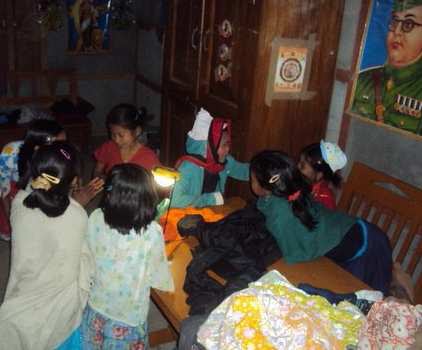
Girls during free time at the hostel
Parents of students are grateful for the school as well, and explain how their children's behavior has changed since they began attending the Alice Project School.  "We are very satisfied with Alice Project teaching
methods and the way of working for the social development. Our children are receiving much benefit and arebeing tamed their young minds with spirituality, morality, and such precious education which will not onlyhelp them now at this tender age but are the base for their whole lives. We did not have any school here where we could send our children. There are some governmental schools but the teachers are not regular and they do not make any effort on moral and spiritual development of our young ones.
After sending our children here at Alice Project we have found lot of changes in their behaviors on daily lives.
They are more social, humble and attentive. We found that they have a new energy and curiosity for learning.
In their normal lives also they are very happy and less stressed.
We are getting good response from the teachers through our children that how efforts are being done. Weaccept that children are getting profit of Alice project quality education. Our children are enjoying theteaching method and learning many new things like Meditation ,prayers, good manners ,singing, dancing, drama and language, yoga, spiritual education all these have changed our children positively on every level. We are sure that all these teachings will make them real human beings the future of the next generation. We feel that we are extremely fortunate to have such a school here.
We are very thankful to all those who are supporting the Alice Project School."

Click here for more photos from the Alice Project School in Arunachal Pradesh.

Click here to learn more and to donate to the Alice Project.


Wednesday, March 6, 2013

Alice Project Schools Help to Combat a Burgeoning Problem in Indian Education


Students at the Alice School
Mangalore, India, March 1: 
According to educationist S. Chandrashekhar Shetty, there is a need for change in the Indian education system. The current system encourages “rote learning,” as students are taught to memorize material for entrance exams rather than think creatively and critically. “Such a system does not encourage students with a scientific bent of mind and innovative aptitude and research. It is some sort of a factory where quantity is there but the quality of the graduates is really suspect,” Shetty told The Hindu.
In recognizing this problem, Alice Project founder Valentino Giacomin has built a unique educational curriculum that emphasizes self-consciousness and the preservation of cultural beliefs alongside traditional learning. This Universal Education methodology allows students to simultaneously cultivate knowledge, understanding, and values, and has been recognized by the Indian government, the international community, and His holiness the Dalai Lama.  Alice schools prepare students to become critical thinkers and good citizens.

Monday, February 11, 2013

Les écoles Alice: un internat, un atelier de couture et l'eau courante


Depuis 4 ans, Friends of Humanity soutient le Projet des écoles Alice en Inde. L'école de  Bodhisata Deban dans la province de l'Arunachal Pradesh, accueille des jeunes filles et enfants issus de la minorité des Chakmas. Sans cette école ils ne pourraient être scolarisés: l'école la plus proche est très éloignée de leur lieu de vie. (plus 4 heures de route sur des pistes impraticables pendant la période de la mousson ).


Dans les sept classes de l’école, 120 enfants de  4 à  14 ans se voient pris en charge pour leur éducation par 7 professeurs qualifiés et peuvent entrevoir une lueur d’espoir pour leur avenir, celui de leur famille et plus largement celui de toute la communauté.

Grace aux dons recueillis par Friends of Humanity et le site de e-commerce shopandhelp.org (jusqu’à 85% du montant des ventes reversé), en 2012 des progrès ont été effectués :

- Une nouvelle salle de bains et une cuisine pour l’internat sont quasiment terminées
 
- l’achat d’un camion « pickup » pour transport de matériels, marchandises et des           
  personnes à travers la jungle.

- L’acquisition d’un générateur pour pallier les coupures de courant et le manque
  d’électricité.

- la construction en dur de réservoirs d’eau pour améliorer le rendement agricole
 
- la création d’une classe de couture pour les jeunes filles


Friends of Humanity tient à remercier tous ses généreux contributeurs 2012 et est déterminé à intensifier son effort en 2013.

Friday, August 17, 2012

New project sponsored by Friends of Humanity in India


Friends of Humanity is proud to sponsor a new project in Alice school in Bodhisatta in India. Friends of Humanity currently supports the school that welcomes 121 children for a period of 20 months.

From now, we will also support the boarding school of Bodhisatta school during 3 years. It welcomes 20 young girls from Chakma minority.
This girls' boarding school is the only chance for them to go to school since their villages are too faraway from the school. In addition, during the monsoon season, the only way to Alice school is blocked ! 
In addition to an access to education, the boarding school provides them with food, lodging and health care.

If you want to have more details on this project, go to our project's webpage !

Help us support this boarding school ! With a donation of only CHF 25, you enable one girl to stay at the hostel and to go to school during one month !

Tuesday, August 7, 2012

International Education Day

Today, we celebrate the International Education Day
On this occasion, let's review the goals being formulated by the international community and the progress made to this day.

Where we should go
  • 2 out of the 8  Millenium Development Goals (MDGs) are bout education:
Goal 2: Ensure that, by 2015, children everywhere, boys and girls alike, will be able to complete a full course of primary schooling 

Goal 3:  Eliminate gender disparity in primary and secondary education, preferable 2005, and in all levels of education no latter than 2015.
  • " Education for all ": programme lunched by the UNESCO
Where we stand (MDG Report 2012)
  • In the developing regions, the net enrolment rate for children of primary school age rose from 82 to 90 per cent between 1999 and 2010.
  • In 2010, 61 million children of primary school age were out of school. One chulrden is event one too many !
  • The female share of out-of-school children dropped from 58 to 53 per cent between 1999 and 2010.
  • 71 out of 131 countries, in developing regions, had achieved gender parity in primary education by 2010. So, in  half of the developing coutries, girls are discriminated against in regards to education !!

Education is one of the key areas in which Friends of Humanity is involved. We currently support a project in India which aims at supporting a school that welcomes 125 children from disadvantaged community. To have more information and donate for this project, go to the project webpage !

Friday, July 20, 2012

Report from Alice school in Boddishata


The purpose of this project is to fund a school in Boddishata that will allow 125 children to have access to a unique education system provided by the Alice Project staff. Friends of Humanity (FOH) will support this school for 20 months.

This report will give you an overall picture of the project’s progress 6 months after the beginning of FOH support. We have asked the school’s staff to answer several questions and thanks to those, we are able to give you some facts about the project.

121 children (out of 125) are currently attending the school. There are as many girls as boys. 65 % of the students are from Boddishata. 7 teachers are working in the school.
Thanks to the money raised, the staff has been able to establish a sewing course to which 12 students already participate. Moreover, the school offers Hindi, English, Moral Science, Mathematics, Yoga classes among many others.

To this day, the budget was spent on: teacher and staff salaries, general expenses, the sewing project and the purchase of a Jeep needed for emergencies.

Local authorities offer moral support to the school. The community members and the students are very grateful for the work done by the school and Alice project staff.

However, one of the results of this report is that the school needs more fund to run independently. Help us to support this school by making a donation !

If you want to have more information about this project, go to the project's webpage !


Tuesday, April 17, 2012

Understanding the People of Arunachal Pradesh, India

Friends of Humanity is a NGO that remains committed to providing aid in a culturally sensitive way. We seek to help people in ways that support their rights as people to maintain a culture. Through understanding the chakmas people of Arunachal Pradesh, India, we can have a better understanding of their unique needs and how to help the Alice School Project improve their lives.
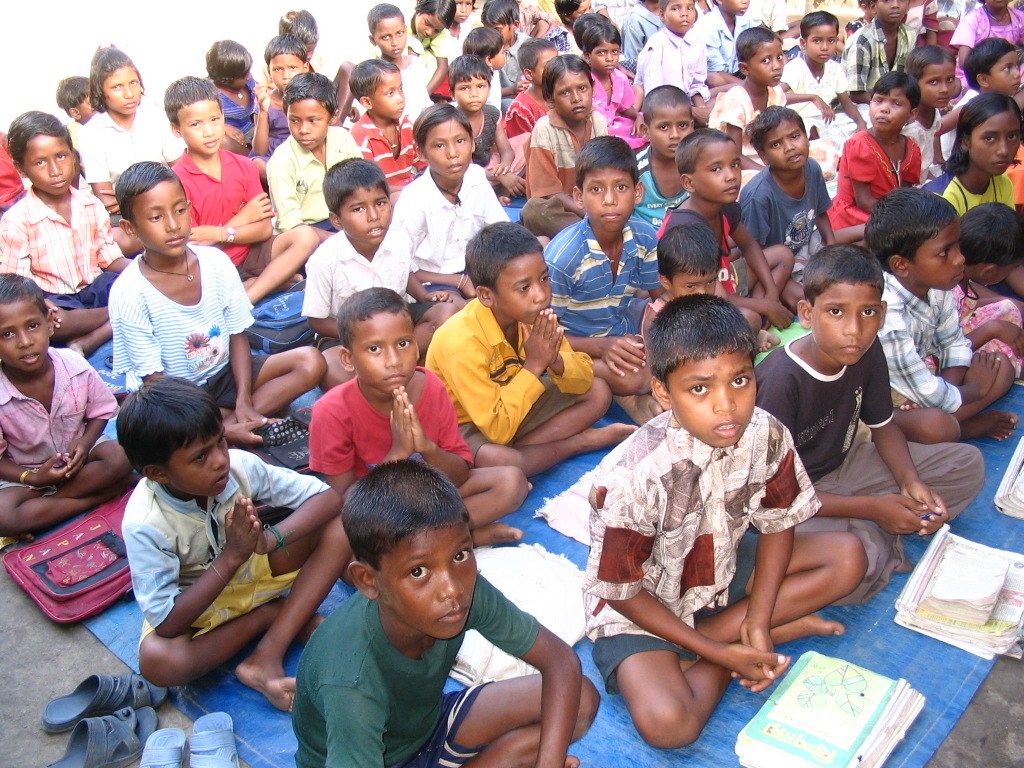
The chakmas are an ethnic group originating near eastern Bangladesh. The ethnic group faced particular disenfranchisement following the 1947 independence of India. When India gained independence from Britain, the state what divided along  religious lines to form the largely Hindu state of India and Muslim state Pakistan. The Indian Partition divided them but they are still very much emotionally attached and share the bonds of same history, language and culture. The Buddhist chakmas faced constant social and violent persecution as part of Pakistan until the state of Bangladesh was formed in 1971 with the help of India. Unfortunately this did not reduce the ill-treatment of this ethnic minority. Now the chakma population is estimated to be around 550,000 between Bangladesh, India, and Burna (Myanmar). As an ethnic minority with a Buddhist tradition, these people are subject to social exclusion and continued xenophobic prejudice

As the chakma people tried to gain independence and exercise self-determination, governments, particularly those of Bangladesh have dealt forcefully with chakma uprisings. The chakmas were largely forced out of their ancestral homelands with the construction of the Kaptai Dam by the then East Pakistan governmment. Traditional areas of cultivatable lands were submerged and thousands were displaced. Many migrated to Diyun, a small township in Arunachal Pradesh, India. However the only seat of political power and self-determination is the Chakma Autonomous District Council in India. This council only represents roughly 35% of the chakmas living in the Mizoram. The Chakmas in Arunchachal Pardesh remain similarly under represented 


In Bangladesh, they have been fighting to regain their own “homeland”; in Mizoram for basic rights and facilities, and in Arunachal Pradesh for a right to nationality. The Chakma peoplea are seen by many as are peace-loving people with a strong work ethic. Their form of agriculture is called “Jhum,” popularly known to the world as “slash-and-burn” method of cultivation or shifting cultivation. Chakmas also call it “Duk Haam”, meaning “hard task.” The Chakmas have their distinct culture, tradition and script. However they face severe culture security concerns. Their written script is dying out because many children lack the opportunity to learn the language in school


Friends of Humanity hopes to elevate the socio-economic status of the chakma people and help preserve their cultural identity through our work with the holistic development strategy of the the Alice School Project. 

Read more in The Chakmas: Life and Struggle by S.P. Talukdar


Thursday, April 5, 2012

Un livre pour soutenir le projet des écoles Alice en Inde

Nous avons reçu le soutien de Philippe Conter en Belgique qui a publié un recueil de citations, En vrac à l'âme. Il a généreusement décidé que le bénéfice de la vente de ce livre irait à Friends of Humanity pour soutenir le projet des écoles Alice dans le nord de l'Inde. Au nom des enfants bénéficiaires du projet et de Friends of Humanity, nous souhaitions le remercier chaleureusement.

Il s'agit d'un très beau recueil de citations qu'il a rassemblé aprés ses rencontres avec le "Padre" :

"Précieuses pépites, onces de sagesse et de spiritualité tamisées, dimanche après dimanche, par le Padre, (86 ans) dans la source aurifère de la "cathédrale" de Clairefontaine (Belgique) et recueillies soigneusement dans cet écrin livresque par Ph. Conter. Des perles de spiritualité mondiale, remplies de générosité et de gratitude pour les jours de "vague-à-l'âme".

Alors si vous souhaitez vous ressourcer dans ce petit livre et en même temps soutenir le projet des écoles Alice en Inde, n'hésitez pas à l'acheter sur Internet, il est diponible pour 10€ sur : The Book Edition.


Le projet des écoles Alice en Inde. Pour faire un don pour ce projet cliquer ici.

Friday, March 30, 2012

FOH President Called to High Level Meeting at UN HQ


Friends of Humanity President and Founder, Graziella Zanoletti received an urgent call to attend a high-level meeting on behalf of FOH partner Alice Project. The meeting "Happiness & Wellbeing: Defining a New Economic Paradigm" was called by Jigmi Y. Thinley, Prime Minister of the Royal Government of Bhutan, at the United Nations Headquarters in New York on April 2nd, 2012. Graziella Zanoletti was asked to attend and represent the Alice Project because the founders of the project, Valentino Giacomin and Luigina de Biasi, could not attend.


The meeting organizers hope "that the high-level meeting will call for the world’s best experts, based on the best available knowledge to work together over the next year to hammer out the details of the measures, accounts, and financial mechanisms required for a happiness-based economic model for the consideration of the international community. Such a model, or aspects of it would then be available for incorporation into national policies on a voluntary basis." These policies were called in response to the UN General Assembly resolution A/65/L.86, introduced by Bhutan with support from 68 Member States, and unanimously adopted by the UN, calling for for a “holistic approach to development” aimed at promoting sustainable happiness and wellbeing. 

Graziella Zanoletti will attend the meeting to report on the unique, sustainable aspects of the Alice Project schools and to provide a solution to address global issues. Alice Project leader Valentino Giacomin wrote a report outlining the information Ms. Zanoletti will present at the meeting: "Alice Project proposes to offer a holistic education in order to fill the inner void that makes the students unhappy...the students follow and practice the teachings of Patanjali, automatically they develop linguistic, logical-mathematical, spatial, interpersonal, intrapersonal, naturalistic, and emotional intelligence." Their unique education system perfectly matches the harmonious development, based on inner wellness, knowledge and collective happiness, that the Kingdom of Bhutan advocates. 

Valentino Giacomin goes on to indicate that these unique efforts have resulted in Alice Project students showing  "happiness." He states "This is what everyone who visits the schools can assess (qualitative evaluation). This kind of Education makes the students less prone to dream high and being more realistic about their target in life, choosing works related to Education (teachers, social workers, agriculture…). In other words, our students have a chance that other students do not have: if all their career dreams fail (as it happens in 90 per cent of the cases for all the students, who are not able to get a job that fit with their University degree and specialization) they have an inner resource where to take refuge, avoiding desperation, frustration and depression: the treasure of their Self (or Soul for religious people). This inner security makes them more flexible and creative, helping them to find, anyhow, a way to survive."

By attending the meeting, Graziella Zanoletti proves that Friends of Humanity supports projects that stand on the cutting edge of development and offer holistic solutions to global issues. Furthermore the call from the Royal Government of Bhutan indicates that non-profit organizations, such as FOH, are playing a key role  creating a sustainable future for all people.
To read more about our work with Alice Project follow this link.


Monday, March 19, 2012

Growing Need To Support Indian Education

There is a growing need to support Indian education as the government  fails to meet meet the mark. Last week the Indian government composed their 2012-2013 Union Budget. The budget failed to allocate sufficient funds towards India's ambitious goal to provide every child in India with education. According to a recent article from the Times of India,  "the finance minister set aside Rs 25,555 crore for implementation of the Right to Education (RTE) Act, up by 21.7% from last year's Rs 21,000 crore, [but] the allotment failed to enthuse experts. Describing the move as 'disappointing", Vinod Raina-an architect of the RTE Act-said: "This year, there is once again a shortfall in funding a fundamental right. It shows how serious the government really is about the RTE (Act).'" 


India's Right to Education Act works to ensure "Every child in the age group of 6-14 years will be provided 8 years of elementary education in an age appropriate classroom in the vicinity of his/her neighbourhood"(source). The government faces particular challenges in providing education to children in urban slums and rural communities. Ethnic minority groups, such as the chakmas, are often socially and economically marginalized and face even more difficulty gaining access to education. The RTE act is an important step in improving living conditions for millions of Indian citizens, but the proposal can only succeed if it is met with long term financial support from the government. 


India stands as the second most populous country in the world, holding an estimated 1.2 billion people. As the world becomes increasingly globalized and interdependent, it seems crucial that we work together to support global development, especially for such a massive player in the world economy. Where the government fails, individual actors must do their part to be the change they want to see in the world.


Read more about Friends of Humanity's India-based partner, the Alice School Project, here.

Wednesday, February 29, 2012

Alice and the struggle against human trafficking find a space at the India Fashion Week

Last week, the Wills India Fashion Week took place in Delhi, and some of the issues that are so dear to Friends of Humanity managed to get the spotlight.

12 among India's top designers presented a creation to support the photographer Subi Samuel and the NGO You Can Free Us who have been fighting for several years against human trafficking. Samuel has recently worked with a young woman rescued from traffickers, and portrayed her wearing the creations of the 12 designers. This photo exhibition is called Ashes from Beauty and it is inspired by Alice in Wonderland, depicting a young girl gradually getting acquainted with a world which initially scares her.

We have been touched to see how the same reference which inspires the work of our partner Valentino Giacomin and his Alice Project with three schools in different regions of India, is also used to tackle the issue of human trafficking, on which Friends of Humanity and our President Graziella Zanoletti have been involved for a long time.

You can read the full article here.

Tuesday, February 14, 2012

Graziella Zanoletti travels to India and visits Alice Project

Last January Friends of Humanity's founder and president, Graziella Zanoletti, traveled to India and spent a few days in Bodhgaya, where the first and biggest Alice Project School is located.

She met Valentino Giacomin (right) and the young students of the school (bottom left), and she verified the progress in the building of infrastructures in Bodhgaya since the partnership with Friends of Humanity began: a hostel for children coming from far away has been built, and ten new schoolrooms are on the way, as well as a big space for meeting and collective meditation.

Graziella received with pleasure the news that the Dalai Lama is helping the Alice Project with a contribution of 18.000 Euros for the expansion of the Bodhgaya site.

Once again Graziella left a bit of her heart with the children of the Alice Project, and came away with a strong motivation to continue supporting them in the future.

Wednesday, January 25, 2012

Another bad rating for quality of education in India

The Indian NGO Pratham published its Annual Status of Education Report (ASER) and, unfortunately but not surprisingly, the average proficiency of students in primary school in India is still very low. Just as an example, more than half of Class 5 pupils cannot read a standard Class 2 text. According to the report, the percentage of students able to perform these basics tasks has dropped since the previous report, but one of the reasons could be that the total attendance of pupils in Indian schools has increased: 96.7% of kids aged 6 to 14 is now enrolled in school, and the dropout has been considerably arrested. The presence in the classrooms of kids who didn't attend school previously can explain the aggregate fall in performance.

In this context we are proud to underline that pupils in Alice Project schools, our partner in India, have generally excellent results and their level of learning enables them to join University, notwithstanding a particularly poor background and starting conditions which are not better than the average Indian Society.

You can read the full article here.

Tuesday, January 17, 2012

New video and new website for Alice Project

Our Italian partners Valentino Giacomin and Luigina De Biasi, founders and inspirators of the Alice Project, have now another way to reach more people to spread the Alice message. A new website is now available, www.aliceproject.it, while the old one continues to exist.

The main information of Alice Project's activity, the ideas behind it, the development of the various schools are explained in a clear and reader-friendly way, both in English and Italian.

On the new website, you can also find the new video shot by  the Italian film-maker Matteo Passigato. For courtesy of Matteo, we can show the video on our blog too!

Passigato has recently interviewed Richard Gere on his activity of support to the Dalai Lama and we are looking forward to see this new work of his.


Alice Project from FilmPRO on Vimeo.

Wednesday, January 11, 2012

Help at hand for poor students seeking admission in quality private schools in India

A Delhi-based NGO, Social Jurist, has opened an all-India helpline to ensure admission of poor students in private schools under the Right of Children to Free and Compulsory Education Act.

Any underprivileged child aspiring to study in good quality school but denied admission can call up the helpline. Social Jurist, which is formed by a group of lawyers, has decided to help those children from weaker sections of the society seeking admission in private schools.

Ashok Aggarwal, one of the advisors, says that the NGO started this nation-wide helpline after they found that even two years after the RTE Act came into force, the poorer sections of the society were yet to get benefit from it: “This is a central act -he says- Besides Delhi and few other states, no other state is taking it seriously. If people lodge a complaint with us, we can write to the concerned state government, get support from the local people and help the concerned party. We can even guide the schools, if they call us,’

The helpline, which was started over a month ago, has received many complaints from Mumbai and Pune. According to the Right to Education (RTE) Act, which came into force from April 1, 2010, 25% seats are reserved for EWS candidates in all private unaided schools. However, private schools in several states and Union Territories have not implemented this provision at all.

Friends of Humanity is always attentive on the issue of education in India, as one of our partners, Alice Project Schools, is active there, with three schools in the towns of Sarnath, Bodhgaya and Bodhisatta.